
Background
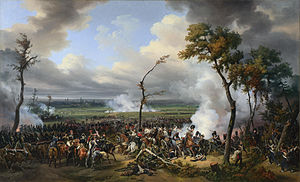
The Battle of Hanau was fought on (30 – 31 October 1813) between Karl Philipp von Wrede’s Austro-Bavarian corps and Napoleon’s retreating French during the War of the Sixth Coalition.
Following Napoleon’s defeat at the Battle of Leipzig earlier in October, Napoleon began to retreat from Germany into France and relative safety. Wrede attempted to block Napoleon’s line of retreat at Hanau on 30 October.


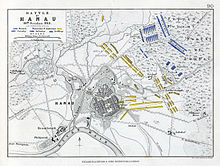
On 29 October, having correctly reckoned that his force was strong enough to block the retreat of a disorganised enemy army, Wrede decided to give battle. He had plenty of time to prepare his dispositions and deployed his army in a relatively narrow and deep order, which was quite sensible, given that his intention was to remain on the defensive. Wrede’s left covered the road to Frankfurt and Mainz, the main retreat route that the French wanted to take. The bulk of his force was positioned along the Kinzig river, on the opposite bank from the city of Hanau, while on his right the divisions of Elbracht and Trautenberg were positioned on the southern bank of the Kinzig. Beckers’s Bavarian division constituted the far right and was deployed on either side of the Kinzig. One regiment, the Austrian Szekler, two battalions strong, as well as a great many skirmishers detached from their parent units were placed in an advanced position in the Lamboy forest. Most of the cavalry was placed in the second line, in the centre, with the artillery quite evenly dispersed throughout the battlefield.[


Meanwhile, Napoleon spent the night of 29/30 October at Isenburg castle, near Gelnhausen, and received detailed intelligence about the Austro-Bavarian preparations, which confirmed that the enemy was intending to make a stand. Napoleon thus directed the army’s baggage and supply train northwards, away from the coalition forces, under the protection of Jean-Toussaint Arrighi de Casanova’s Cavalry Corps, while leading his remaining forces in a frontal manoeuvre against Wrede’s force. He ordered Victor to form the left wing with his Army Corps and march along the Kinzig, while MacDonald’s Corps and the Guard were to penetrate the Lamboi forest. Part of the Guard cavalry under General Charles Lefebvre-Desnouettes was detached further north to cover the flank of the army. Napoleon studied Wrede’s position and spotted its main weakness, namely that he had most of his army deployed with the river behind it, which would act as a natural barrier should retreat be necessary. Upon seeing Wrede’s dispositions, Napoleon sarcastically noted: “I have made Wrede a Count but it was beyond my power to make him a General.” However, in order to exploit this potentially fatal weakness in Wrede’s deployment, Napoleon first had to beat him, and do so with an inferior number of infantry, less cavalry and fewer cannons, fighting against an enemy who had all the time it needed to deploy its forces for defense.


Wrede, following successful skirmishing against the French, began to deploy his forces to face the main French force of 20,000. On 30 October Wrede placed his centre with the River Kinzig behind it, and his right wing to its south in an isolated position with only a single bridge linking it with the main force. Napoleon had only 17,000 troops including Marshal MacDonald’s infantry and General Sébastiani’s cavalry to face the enemy forces blocking them. Due to dense forests on the east of Wrede’s positions the French were able to advance and make close contact with the allies almost unseen. Napoleon decided to attack the allies’ left with all available troops. By midday Marshal Victor and MacDonald had cleared the forest in front of the allies’ centre. Soon after, General Drouot found a track in the forest towards Wrede’s left on which cannon could be moved. Three hours later Grenadiers of the Old Guard had cleared the area of allied troops and Drouot began to deploy 50 cannons supported by cavalry of the Guard and Sébastiani. A brief artillery bombardment from Drouot’s cannons silenced Wrede’s 28 cannons. French cavalry then attacked and pushed back Wrede’s cavalry on his left flank, then attacked the flank of Wrede’s centre. Wrede’s centre started to fall back, skirting the banks of the Kinzig River and suffering heavy casualties. On the right wing, Wrede’s forces tried to cross the single bridge over the Kinzig River to reinforce the centre, but many drowned in the attempt. Wrede was successful in rallying his troops to form a defensive line running from Lamboy Bridge to the town of Hanau. During the night the allies abandoned Hanau. The French occupied Hanau on 31 October with little resistance. Napoleon made no effort to pursue Wrede, the main road to Frankfurt was now reopened, the French retreat continued.
https://en.wikipedia.org/wiki/Battle_of_Hanau


The Game
The game was set up using the historical battle map converted to a four foot by six foot table. Terrain was placed to approximate the historical locations. All forces were organized from the historical orders of battle.

We decided to use our own brigade variant of the popular Black Powder rules. Each unit on the table represented a Brigade of Infantry or Cavalry or a grouping of Artillery. The primary differences in the variant is the ranges of weapons fire (much shorter) and the simplification of formations.

Early Game: The Bavarians set up in their starting positions and awaited the French attack. The French began by assaulting through the woods on their left. This resulted in both forces being worn down and neither side being able to gain the advantage.

Mid Game: As the French forces stated to arrive in strength, they decided to deploy their artillery in the center and start shelling the allied positions. The allies were content in solidifying their lines and awaiting the French attack. The idea was that this would be done until more forces arrived to restart the advance. At the same time, the forces on the left kept attacking, trying to wrestle an advantage.

Late Game: The French continued their artillery bombardment for a bit long and finally launched their initial assaults against the Allied center and left. These attacks met with limited success. Finally, with time running out, the Guard was committed to clear the right flank. Unfortunately, this was too little too late and time ran out. The game ended as an unhistorical allied victory!

- Manteuffel