
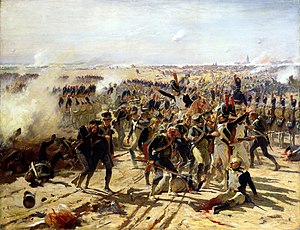
In the Battle of Aspern-Essling (21–22 May 1809), Napoleon attempted a forced crossing of the Danube near Vienna, but the French and their allies were driven back by the Austrians under Archduke Charles. The battle was the first time Napoleon had been personally defeated in over a decade. However, Archduke Charles failed to secure a decisive victory as Napoleon was able to successfully withdraw most of his forces.


At the time of the battle Napoleon was in possession of Vienna, the bridges over the Danube had been broken, and the Archduke’s army was near the Bisamberg, a hill near Korneuburg, on the left bank of the river. The French wanted to cross the Danube. A first crossing attempt on the Schwarze Lackenau on 13 May was repulsed with some 700 French losses.Lobau, one of the numerous islands that divided the river into minor channels, was selected as the next point of crossing. Careful preparations were made, and on the night of 19–20 May the French bridged all the channels on the right bank to Lobau and occupied the island. By the evening of the 20th many men had been collected there and the last arm of the Danube, between Lobau and the left bank, had been bridged. Masséna’s corps at once crossed to the left bank and dislodged the Austrian outposts. Undeterred by the news of heavy attacks on his rear from Tyrol and from Bohemia, Napoleon ferried all available troops to the bridges, and by daybreak on the 21st, 40,000 men were collected on the Marchfeld, the broad plain of the left bank, which was also to be the scene of the Battle of Wagram.


The Archduke did not resist the passage. It was his intention, as soon as a large enough force had crossed, to attack it before the rest of the French army could come to its assistance. Napoleon had accepted the risk of such an attack, but he sought at the same time to minimize it by summoning every available battalion to the scene. His forces on the Marchfeld were drawn up in front of the bridges facing north, with their left in the village of Aspern (Gross-Aspern) and their right in Essling. Both places lay close to the Danube and could not therefore be turned; Aspern, indeed, is actually on the bank of one of the river channels. The French had to fill the gap between the villages, and also move forward to give room for the supporting units to form up.


The corps led by Johann von Hiller (VI), Heinrich Graf von Bellegarde (I) and Prince Friedrich of Hohenzollern-Hechingen (II) were to converge upon Aspern, while Prince Franz Seraph of Rosenberg-Orsini (IV) was to attack Essling. Prince Johann of Liechtenstein’s Austrian reserve cavalry was in the center, ready to move out against any French cavalry attacking the heads of the columns. During the 21st the bridges became more and more unsafe, owing to the violence of the current, but the French crossed without intermission all day and during the night.


The French lost over 20,000 men including one of Napoleon’s ablest field commanders and close friend, Marshal Jean Lannes, who died after being mortally wounded by an Austrian cannonball in an attack on Johann von Klenau’s force at Aspern, which was backed up by 60 well-placed guns. French general Louis-Vincent-Joseph Le Blond de Saint-Hilaire also died as a result of injuries from the battle; his leg was torn off by a cannonball. The Austrians had also suffered similar casualties but had secured the first major victory against the French for over a decade. The victory demonstrated the progress the Austrian army had made since the string of catastrophic defeats in 1800 and 1805.


The French forces were withdrawn to the island. On the night of the 22nd the last bridge was repaired, and the army awaited the arrival of reinforcements in Lobau. The Austrians, surprised by their victory, failed to capitalize on the situation, allowing the French to regroup. One month later, the French made a second attempt to cross the Danube where Napoleon gained a decisive victory over the Austrians at the Battle of Wagram.
https://en.wikipedia.org/wiki/Battle_of_Aspern-Essling

The Game
Continuing on our 1809 battles scenarios, we decided it was time to try the first day of Aspern Essling. Once again, we used Bloody Big Battles wargame rules. The OOB was based on widely published sources. The troop scale was 500 men per infantry base, 300 men per cavalry base and 12 guns per artillery base. Troop quality varied by unit, with the French having many generals represented, but Austrians having only two generals and a large number of passive units (to represent their poor coordination). We also tried out adding a new rating to select cavalry units of K (for shock). These units get an extra +1 in melee. This rule is one that is on the BBB Yahoo message boards and recommended by the rules author (in our opinion, the rule works very well in this period of effective cavalry). The scenario victory conditions revolved around the towns of Aspern and Essling. For either side to win, they would have to hold both towns. Any other result would be a draw.

The general game plan of the Austrians was to stretch out the French and focus their infantry on frontal attacks on both of the towns. The French strategy was to hold the towns and counter the Austrian moves. In order to hold the center, the Austrians deployed most of their guns in the gap to cover lateral movement by the French. Initially, the French held their cavalry in the center, as a reserve. As the Austrian attacks became clearer, the French committed their cavalry to the flank to destroy their Austrian opposite numbers. This fight turned out to be one sided, with the French grinding down the Austrian Cavalry pretty decisively. The French doggedly held the terrain around both towns, while the Austrians finally worked their way into both towns. The French launched multiple counter attacks, but the Austrians seemed to have the upper hand. Then, with night rapidly approaching, the French committed their forces for one last attack. The columns surged forward and successfully through back the Austrians from both Aspern and Essling. With the towns lost and the Austrian forces heavily attritted, the day belonged to the French!

_ Manteuffel
Sounds like a good even fight with some ebb and flow to it. Thanks for the AAR!
Victory for almost every BBB battle we have played has been determined on the last turn!
Well done, excellent game mat.
I like the ‘K” rule for cavalry and the different troop scale for cavalry. Perhaps my Marengo scenario needs to be revisited with this in mind.
Yes, we use the K rule and lower scale for Napoleonic battles, as we feel it boosts cavalry to better represent the period.