
Background
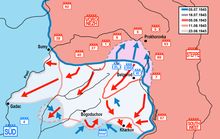
The Belgorod-Kharkov Strategic Offensive Operation, or simply Belgorod-Kharkov Offensive Operation, was a Soviet strategic summer offensive that aimed to recapture Belgorod and Kharkov (now Kharkiv) , and destroy the German forces of the 4th Panzer Army and Army Detachment Kempf. The operation was codenamed Operation Polkovodets Rumyantsev(Russian: Полководец Румянцев), after the 18th-century Field Marshal Peter Rumyantsev and was conducted by the Voronezh and Steppe Fronts in the southern sector of the Kursk Bulge. The battle was referred to as the Fourth Battle of Kharkov by the Germans.

The operation began in the early hours of 3 August 1943, with the objective of following up the successful Soviet defensive effort against the German Operation Citadel. The offensive was directed against the German Army Group South’s northern flank. By 23 August, the troops of the Voronezh and Steppe Fronts had successfully seized Kharkov from German forces. It was the last time that Kharkov changed hands during the Soviet-German War. The operation led to the retreat of the German forces in Ukraine behind the Dnieper River and set the stage for the Battle of Kiev in autumn 1943.

By re-establishing a continuous front on Army Group South’s left flank, the 4th Panzer Army and the 8th Army had for the moment, blunted a deadly thrust, but to the north and southeast fresh blows had already been dealt or were in the making. Employing the peculiar rippling effect that marked their offensives, the Red Army, thwarted in one place, had shifted to others. For the first time in the war they had the full strategic initiative, and they used it well. The failure of Operation Citadel meant the Germans permanently lost the strategic initiative on the Eastern Front without any hope of regaining it, although Hitler refused to acknowledge it. The large manpower losses of the Wehrmacht in July and August 1943 severely restricted both Army Groups South & Centre to react to future thrusts during the winter and 1944. Operations Polkovodets Rumyantsev, along with the concurrent Operation Kutuzov marked the first time in the war that the Germans were not able to defeat a major Soviet offensive during the summer and regain their lost ground and the strategic initiative.

Losses for the operation are difficult to establish due to large numbers of transfers and missing in action. Soviet casualties in the Belgorod–Kharkov sector during this operation are estimated to be 71,611 killed and 183,955 wounded; 1,864 tanks, 423 artillery guns, and 153 aircraft were lost.[4][5] German losses were at least 10,000 killed and missing and 20,000 wounded. German tank losses are estimated as several factors lower than Soviet tank losses.
https://en.wikipedia.org/wiki/Belgorod-Kharkov_Offensive_Operation

The Game
As we only had a couple of players and it was the last game of Kursk month, we decided to try a scenario we found on the old WWPD site and give it a whirl. The scenario represents fighting that kicked off the Russians counter attacking the Germans after Operation Citadel was called off. We did not have all the KVs, so replaced five with a force of 10 T-70s (which turned out to be a mistake). The scenario was designed with version 2 or 3 in mind. We played it using version 4. In retrospect, if we did it again, we would either add another infantry platoon to the Germans or double the number of tanks that had to exit to compensate for the substantially faster movement in version 4.
http://network.wwpd.net/pdf/ValleyofDeath.pdf


Winning Conditions: The Soviet player wins if they exit 10 tanks off the West table edge, or if they have forced the Germans to leave the
field of battle. Each German AFV eliminated counts as one less tank needed to this total. E.g. If two German tanks are destroyed then the Soviet player only needs to exit eight tanks. The German player wins if they avoid the Soviet victory conditions, or if they have forced the Soviets to leave the field of battle.


ELEMENTS OF 2nd SS ‘DAS REICH’ PANZER DIVISION (FEARLESS VETERAN):
- Company Command: Pz V D Panther
- Schwere Panzer Platoon: 2 x Pz VI Tiger
- PzJager Platoon: 2 x Hornisse
- Pioneer Platoon (all tank assault 4): 1 x Command SMG team 6 x Rifle/MG teams


ELEMENTS OF 5th GUARDS TANK ARMY (Confident Consript)
- Battalion Command: 1 x T34-76 (with cupola)
- 1st Tankovy Polk: 10 x T34-76 (with cupola)
- 2nd Tankovy Polk: 10 x T34-76 (with cupola)
- 1st Guards Heavy Tank Company: 5 x KV-1e
- 1st Light Tank Company: 10 x T-70


Set Up and Planning: The Germans set up with their infantry at the back of the board to act as a final road block. The HQ was set up in the center and the longer range Nashorns and Tigers covered both flanks. The plan was to engage the Russians at max range and use shoot and scoot orders to concentrate towards the main attack over time. The Soviet plan was to feign right and then send all their medium and light tanks to the left to sweep through the Nashorns.

Early Game: The Soviets brought their KVs and one group of T34s along the right side at full speed, to close the gap with the Germans as fast as possible. The Germans took long range fire and destroyed a number of T34s.

Mid Game: The Soviets continued to push their KVs at full speek towards the Tigers to keep their attention. The right hand side T34s moved to the center and were joined by the other T34 company and the T-70s. The Soviets were able to pull off a golden BB shot and kill the command Panther.

End Game: The Soviets continued to push their KVs past the Tigers. The Tigers managed to fail all their shoot and scoot orders during the game and were equally challenged in hitting KVs. At the same time, the Soviets sent their entire force to the left to try to get through the Nashorns. The Germans successfully shifted their infantry to block the Soviet advance. However, the mass of fire was too much for the Nashorns and they were both destroyed. This left it up to the poor bloody infantry. They bravely through back the Soviet assaults two turns in a row, but the Soviets were finally open to open up a small gap with fire and forced their way through. Even the KVs managed to hold on against the hunting Tigers. The game ended as a solid Soviet victory.
– Mantueffel