Background
The Battle of Gazala (near the modern town of Ayn al Ghazālah) was fought during the Western Desert Campaign of the Second World War, west of the port of Tobruk in Libya, from 26 May to 21 June 1942. Axis troops of the Panzerarmee Afrika (Generaloberst Erwin Rommel), consisted of German and Italian units. Allied forces (Commander-in-Chief Middle East, General Sir Claude Auchinleck), were mainly British, Indian, South African and Free French.


Early on 29 May, supply vehicles supported by the “Trieste” and “Ariete” divisions, worked through the minefield north of Bir Hakeim and reached the Afrika Korps. On 30 May, Rommel pulled the Afrika Korps back westward against the edge of the minefields, creating a defensive position. A link was formed with elements of the Italian X Corps, which were clearing two routes through the minefields from the west. In the process, the Sidi Muftah box was overrun and the 150th Infantry Brigade destroyed,
In the afternoon [30th May] I personally reconnoitred the possibilities for an attack on Got el Ualeb [the Sidi Muftah box] and detailed units of the Afrika Korps, 90th Light Division and the Italian Trieste Division for an assault on the British positions next morning. The attack was launched on the morning of the 31st May. German-Italian units fought their way forward yard by yard against the toughest British resistance imaginable.[…] Nevertheless, by the time evening came we had penetrated a substantial distance into the British positions. On the following day the defenders were to receive their quietus. After heavy Stuka attacks, the infantry again surged forward against the British field positions.[…] Piece by piece the elaborate British defences were won until by early afternoon the whole position was ours. The last British resistance was quenched. We took in all 3,000 prisoners and destroyed or captured 101 tanks and armoured cars, as well as 124 guns of all kinds.
— Rommel
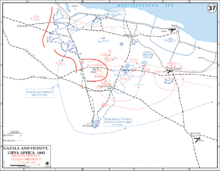


Acting on mistaken reports about German tank losses, Auchinleck strongly urged Ritchie to counter-attack along the coast, to exploit the absence of German tanks and break through to Timimi and then Mechili. Ritchie was more concerned by Tobruk, brought reinforcements up to the El Adem box and created new defensive boxes opposite the gaps in the minefield. Ritchie ordered the Eighth Army to counter-attack against the Afrika Korps on 5 June but they were met by accurate fire from tank and anti-tank guns positioned in the cauldron. In the north, XIII Corps made no progress but the attack by 7th Armoured and 5th Indian divisions on the eastern flank of the cauldron at 02:50, initially went well. An important element of the plan was the destruction of the Axis anti-tank screen with an artillery bombardment but because of an error in plotting its position, the bombardment fell too far to the east. When the 22nd Armoured Brigade advanced, it was met by massed anti-tank fire and the advance was checked. The 32nd Army Tank Brigade advancing from the north, joine
d the attack at dawn but also ran into massed fire, losing fifty of seventy tanks.
The Game
The scenario represents elements of the British 22nd Armoured Brigade attacking units of the Arieti Division along the western side of the cauldron.
Italians
Two Forces of 2000 points. First force is a Bersiglari company. This force may not have any tank support, but must contain one battery of 90mm SPAA. The second force is armor and may only contain tanks. Tanks must include Semoventis.
British
The British have two forces. One force is a Crusader tank company and the other is a Honey tank company. The British forces may only tank armored tank teams in their force. Tanks chosen can be Honeys, Crusader IIs, Crusader CS, Crusader IIIs (no more than one per troop), Grants (as support options) and armored cars.
Terrain
The board is 5″ x 10″. The only terrain are random rises and hills. In addition, one rocky outcrop in the Italian deployment zone.
Set Up
Italians set up Bersiglari Company on the table. Set up zone is diagonal from one corner to the other. Italian reserves arrive anywhere along the long or short table edge behind their deployment zone. British enter in on any of the other two table edges.
Victory
Successfully break one of the opponents two formations to win.
Game Recap
The Italians built their Bersiglari around two infantry companies, each supported by a battery of 100mm artillery and 47mm ATGs. In addition to the 90mm SPAA, they had air support. All units were dug in close together, using the rock outcrop as flank protection. The British decided to take one company of Crusaders and the maximize the number of Honeys with Grants in support. The British decided to hold one of their formations in reserve, for entry on turn 4. The rest of the formation entered on the short table edge.
Early Game
The British sent their Crusaders against the dug in Italians, hoping to trigger their ambushes and work the flank. The first group of Honeys entered the short table edge and were directed to the far Italian flank. The crusaders jockeyed around in troops against the Italian infantry and guns, getting the worse end of the bargain. The Honeys moved forward across the table. The Italian reserves began to arrive and deployed as far from the Honeys as possible, to give the rest of their formation time to enter the table.
Mid Game
The British Crusaders decided to back of from their attack, as their losses were starting to mount. The British reserves entered the table and followed the first wave of Honeys towards the waiting Italian tanks, sending the Grants to support the Crusaders. The Honeys swept forward, taking a number of losses, but also inflicting casualties on the Italian tanks. With no pressure from the Crusaders, the Italians deployed their ambushes and swung their guns against the attacking Honeys, putting them into a cross fire.
End Game
Seeing the carnage, the Crusaders decided to re-engage, with Grants in support. This drew some of the fire from Honeys, but was too late to turn the tide. The Italian armor had taken heavy losses, but was still holding on by its figure nails. However, the Honey’s had had enough and quit the field. The game resulted in a historic axis victory!
– Manteuffel


