


This is the report of the fourth game of our Gallabat-Metemma campaign. Game 1 saw the capture of Fort Gallabat by British and Indian forces. Games 2 and 3 featured counterattacks by Italian-led Eritrean forces that resulted in heavy casualties to the Eritreans. (See our previous reports of those games.)


Those games advanced our campaign timeline from dawn to early-afternoon on 6 November 1940. After the defeat of the Italian counterattacks, the fighting on the ground died down as both sides regrouped and recovered. The Italian air force made two more appearances over the battlefield (the effects of which were resolved off-table by the umpire). The air strikes were focused on the British troops holding Fort Gallabat, which resulted in the Essex battalion becoming unfit for offensive action.


Thus, at sunset on 6 November, the British had at their disposal: one battalion of Baluchi infantry (twelve platoons in four companies, represented by British and Australian figures in the game), that was relatively fresh and nearly at full strength; eight heavy machine guns; six operational tanks (two A9 Cruisers and four Vickers light tanks); and three artillery batteries. The Italians had: seven platoons of Eritrean infantry (represented by Italian figures in the game); eight heavy machine guns; and two batteries of light artillery. The superior forces of the British gave them the initiative — could they now follow up their successes to capture the Italian fort at Metemma and win the campaign?
The map on this site shows the operational area:
http://www.kaiserscross.com/96801/571722.html
The map on this site shows the slope that cuts through the village of Metemma:
https://www.ibiblio.org/hyperwar/UN/India/EAfrica/img/IAF-EAfrica-11.jpg
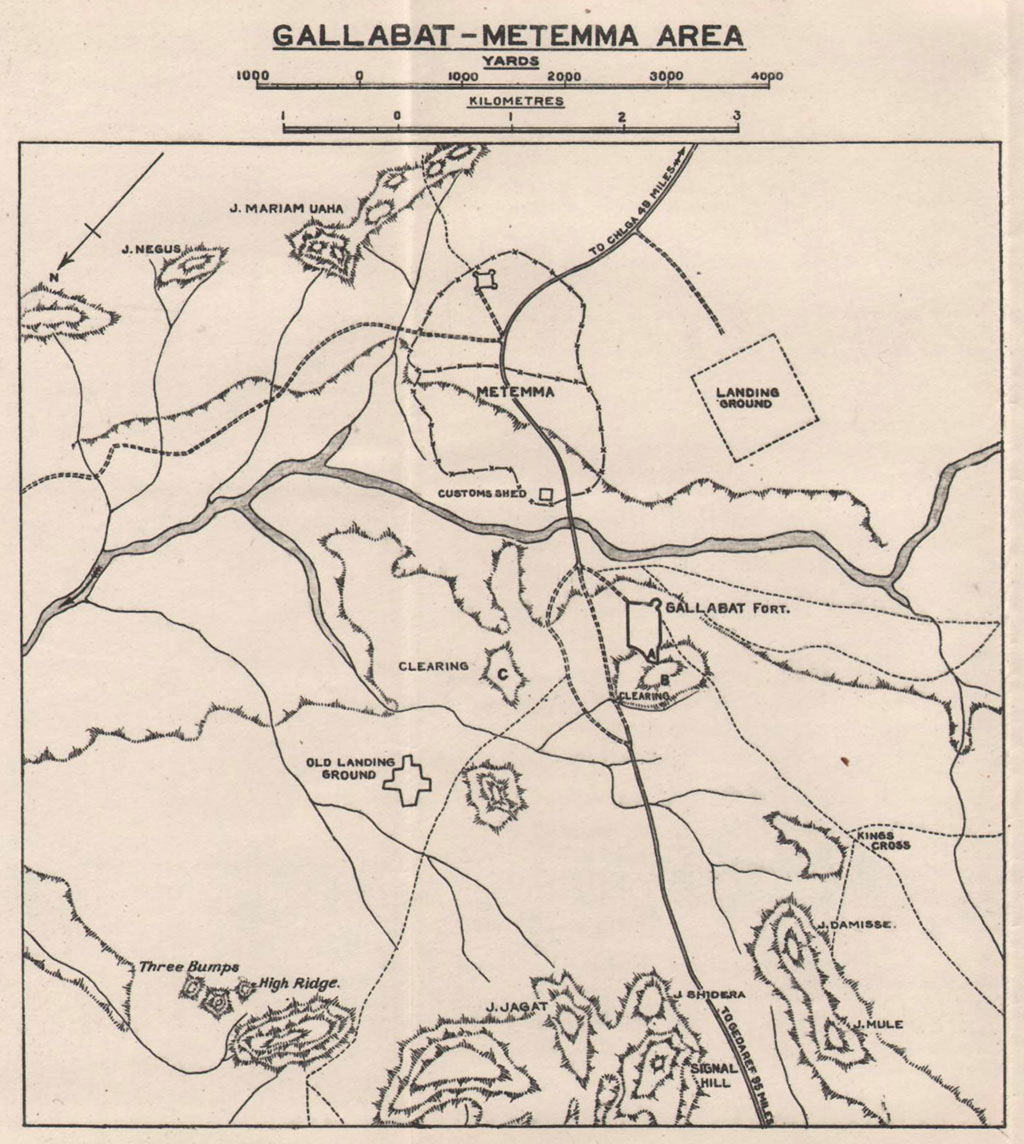


The key terrain for Game 4 would be the fortified area of Metemma, which was composed of a village of dispersed huts located near the border with Sudan, and a military compound located on higher ground to the south. The entire area was about one mile wide by 1.5 miles deep. Both the village and the military compound were encircled by barbed wire and/or zariba (a barrier made of thorn bushes), including a belt of wire that separated the village from the military compound. The lower village and the military compound were also separated by a rocky slope. Outside the wire to the east ran the Khor Miriam Waha, which was a dry stream bed. Beyond the khor to the southeast was a ridge named Jebel Miriam Waha. Other than these features, the ground outside the wire was relatively flat and open.


The wire/zariba around the military compound was pierced by three gates located on the northern, eastern, and southern sides of the perimeter. A small fort was located in the southeast corner of the compound. The western side of the compound contained a row of barracks buildings. A supply depot was near the southern gate. Some native huts enclosed by zariba were scattered around the compound (prior to the game, the Italians elected to remove the zariba from some of the huts).


Before Game 4 began, the Italian/Eritrean team experienced a change of command (the previous player-commander could not attend this game). The new Italian commander opted to pull all of his surviving forces back to the military side of Metemma, abandoning the village. In addition to the hard cover provided by the fort, barracks, and supply buildings, the Italians were allowed to place four platoon-sized entrenchments, which they placed near the three gates and on the western side of the perimeter. Two small minefields were placed to obstruct the northern and eastern gates. The Italian guns were emplaced in weapons pits in the center of the compound. Two askari platoons were deployed in the fort, two platoons were in the barracks, and the other three platoons manned the entrenchments near the three gates. The machine guns were distributed to the platoons.


The Eritrean askaris must have been heartened by the change of commanders because their morale remained Confident; however, it was a bit shaky. If either the fort, the barracks or the supply depot were to fall into enemy hands, Eritrean morale would drop to Reluctant. If two of those objectives were lost, morale would collapse, and the British would win the game (and the campaign).

Without knowing the Italian plans or deployment, the British commander was asked how he planned to attack Metemma. His plan was to wait until sunset, then concentrate all of his available forces and make a direct attack from Gallabat to Metemma during the night. (The British tanks could only cross the Boundary Khor via the bridge at Gallabat which limited their axis of advance, although the infantry could cross the khor at any point, and move anywhere.) After clearing Metemma village, the four companies of Baluchis would spread out into a line. Two companies would make a frontal attack on the military compound from the north, and the other two companies would maneuver to attack each flank of the compound. Two tanks would support each sector of the attack. The three off-table batteries of artillery were pre-registered on the fort, the barracks area, and the supply depot. Initially, the effect of this area fire would only serve to pin any targets that were hit — the fire would only become destructive once the targets were spotted by on-table observers.


With both sides’ plans and deployments determined, we could set up the table. Our 9X5 foot table was set with the long axis running east-west. The rocky slope that divided the village of Metemma from the military compound ran along most of the northern edge of the table (the defenders were deployed far enough back from the top of the slope that they could not see the lower village, so the slope itself could form the table edge). Khor Miriam Waha ran along the eastern edge of the table, and the western end of the table was open ground. Because the British were not attacking the rear of the compound, the southern edge of the table could run just outside the southern perimeter.


On Turn 1, all of the British forces entered from the northern edge of the table. In the west, two Vickers light tanks and an infantry company began to move around that flank of the compound. In the center, two infantry companies in line advanced to the foot of the slope, while two light tanks used the road to approach the front gate. In the east, an infantry company began to advance up the khor, supported by two Cruiser tanks. British artillery landed on its predesignated targets, pinning three Eritrean platoons.


The Italian half of Turn 1 passed with no response, as the Italians could not see anything yet. On Turn 2, the British in the west continued to advance around the compound. The infantry in the center advanced up to the wire, while the light tanks moved up to the gate. In the east, the infantry continued to advance up the khor, but the Cruiser tanks could not climb up the rocky slope. One Cruiser struck a rock and was disabled (rolled a 1), and the other Cruiser was bogged down for several turns (could not roll a 4+).


The Baluchis along the northern perimeter wire were now spotted, and the Italian artillery ranged in on them, knocking out a few teams and pinning some platoons. An askari platoon unpinned and moved from its position near the rear gate toward the vacant trenches on the western perimeter. A platoon in the fort unpinned and moved toward the center of the table, where they could better support the guns. The askari platoons nearest the northern perimeter fired small arms and machine guns at the Baluchis to their front. There was a wide gap in the defenses between the entrenchments at the northern gate and at the eastern gate, hence most of the Italian fire was focused on the threats coming from that direction.


On Turn 3 the Fearless Baluchis unpinned and began to cross the wire along the northern perimeter. Two assaults were made on the entrenchment at the front gate. One assault captured half of the entrenchment, but the other was beaten off. Meanwhile, two Vickers tanks forced their way through the gate and struck the minefield. One tank was immobilized and the other was unharmed and entered the compound.


Shortly after that, the Eritreans manning the entrenched position at the eastern gate were assaulted from two directions, and were forced to give up the forward half of the position.


Fortunately for the defenders, the partial successes achieved at the northern and eastern gates, combined with the casualties that were accruing among the platoons in the center, induced the British commanders to abandon the advance in the center, and they shifted those platoons toward the fighting at the two gates. The Italian commanders were greatly relieved by this development. They shifted the platoon that was defending the guns in the center to support the platoon at the eastern gate, and moved some teams from the barracks to reinforce the defense at the main gate. Italian artillery and machine gun fire also shifted to support these two positions. With the commitment of these additional assets, the Italian defenses at the gates stiffened and held.


Meanwhile, the Baluchi company and the two light tanks in the west continued to creep around the western perimeter, probing for a weakness. One platoon infiltrated into the compound and occupied some of the trenches along the western fence, but could not push past the askaris that were holding the rest of the trench. The tanks and two platoons headed for the rear gate, near the now vacant supply depot. This move was spotted by the Italians, who ordered their reserve platoon to move from the barracks to the supply depot.


So far, the British artillery had achieved very little. The most important enemy targets were too close to friendly troops, so the artillery focused on suppressing and eliminating the Italian guns. Two 75mm guns were knocked out, but the Fearless Italian crews stood by their guns and continued to pound the Indian troops.


At the end of the game, two light tanks and two platoons of Baluchis reached the back gate. Having discovered mines at the other two gate, the tanks did not try to force the gate (it was not mined), and instead halted outside the perimeter to provide fire support. The Baluchis crossed the zariba and assaulted the supply depot. Against the odds, the defenders in the depot stopped the assault!


At that point, with their advances halted in every sector, and with 2/3 of their infantry platoons suffering heavy casualties, and with the Italian defenses still looking solid, the British commanders ordered their troops to break off the attack and return to Gallabat. The Italians had pulled off an unlikely win!


After advancing, attacking, and retreating throughout the night, the British would have no forces capable of offensive action on the following day, 7 November. Although the Eritrean troops were also exhausted, continued Italian air attacks were expected throughout the day on the 7th. The British also knew (from decrypted radio intercepts) that a column of Italian reinforcements was due to arrive on the 8th. Hence with the failure of this attack, the British campaign to capture Metemma had culminated. Our Gallabat-Metemma campaign was over, with a come-from-behind Italian/Eritrean victory!


- TJ